Folic acid is the man-made form of folate, a B vitamin (vitamin B9) that contributes to normal blood formation.1,9 Adult men in the UK need 200 micrograms (µg) of folate a day, and most can get that from a varied diet. The NHS advice to take a 400 microgram folic acid supplement is aimed at women who are trying to get pregnant.1,3
If you're a man trying for a baby with your partner, you've probably seen folic acid on the label of men's fertility supplements. The largest trial so far, in 2,370 men whose partners were planning fertility treatment, found that a high daily dose of folic acid with zinc did not improve semen quality or the chance of a live birth.4
- Adult men need 200 micrograms of folate a day, and a varied diet with greens, pulses and fortified cereals usually provides it.1
- The NHS advice to take 400 micrograms of folic acid a day is for women who are trying to conceive. There is no equivalent UK recommendation for men.3
- In the largest trial, 5 milligrams (5,000 micrograms) of folic acid plus 30 milligrams of zinc a day for six months did not improve semen quality or live birth rates.4
- Earlier small trials reported higher sperm counts, but the largest trial found no benefit for live birth, and reviews of men's fertility supplements, including folic acid, have not shown a clear benefit for live birth either.4,5,6,7
- Keep folic acid from supplements and fortified foods at 1,000 micrograms a day or less unless your doctor advises more. High doses can hide the signs of low vitamin B12, which can lead to nerve damage if it is missed.1,8
- No authorised health claim in Great Britain links folate to male fertility.9
- If you have been trying for a year or more, see your GP. Both partners are usually assessed, and for men this normally includes a semen analysis.15
What does folic acid do in men?
Folate is a B vitamin that contributes to normal blood formation.1,9 Folic acid is the man-made form used in supplements and fortified foods, while folate is the form found naturally in foods such as leafy greens, peas and beans.1 Your body has no long-term store of folate, so you need folate-containing foods often.1
Researchers have also studied how folate relates to adding chemical tags to DNA, a process that helps control which genes are switched on and off.2 Sperm are made continuously in the testes through repeated cell division, so researchers have long asked whether folate plays a part in sperm production. A 2007 review in Human Reproduction Update discussed folate among the nutrients that may be involved in spermatogenesis, the process that makes sperm.10
Whether a supplement improves sperm production is a separate question, and it is the one the trials further down this page tested.
This also shapes what you read on supplement labels. In Great Britain, food and supplement labels can only use health claims listed on the GB Nutrition and Health Claims Register. Folate claims that apply to men include that folate contributes to normal blood formation, to normal homocysteine metabolism and to normal psychological function.9 Homocysteine is an amino acid in your blood, and folate is one of the nutrients your body uses to process it.2 None of the register's folate claims mentions sperm, testosterone or male fertility.9
How much folic acid should a man take?
Adult men need 200 micrograms of folate a day, and the NHS says most people should be able to get this from a varied and balanced diet.1 There is no UK recommendation for men to take a folic acid supplement for fertility. The 400 microgram daily supplement the NHS advises is for women who are trying to get pregnant, ideally from three months before conception until 12 weeks of pregnancy.3
If you already take a supplement that contains folic acid, such as a men's multivitamin, add up the folic acid across everything you take. The NHS says taking 1 milligram (1,000 micrograms) or less of folic acid a day is unlikely to cause any harm.1 The European Food Safety Authority (EFSA) reviewed the evidence in 2023 and kept its tolerable upper intake level (the most it considers safe to take every day over the long term) at 1,000 micrograms a day for adults. The limit covers folic acid and any other added form of folate, such as methylfolate, from supplements and fortified foods. It does not cover the folate naturally in food.8
The main reason for the limit is vitamin B12. The NHS says doses of folic acid higher than 1 milligram (1,000 micrograms) can mask the symptoms of vitamin B12 deficiency, which can eventually damage the nervous system if it's not spotted and treated.1 EFSA set its limit to protect people with low B12 from worsening nerve symptoms.8 If you've been told your B12 is low, or you're thinking about a high dose of folic acid for any reason, talk to your GP first.
From December 2026, non-wholemeal wheat flour in the UK will be fortified with folic acid at 0.25 milligrams (250 micrograms) per 100 grams of flour. This is mainly to lower the risk of neural tube defects, such as spina bifida, in babies.11 That adds a modest amount of folic acid to everyday foods such as bread, which is one more reason to keep any supplement dose sensible.
Folic acid amounts at a glance
| Amount a day | What it is | Who it applies to |
|---|---|---|
| 200 micrograms of folate | UK daily need for adults1 | Men and women; usually met through a varied diet |
| 400 micrograms of folic acid | NHS supplement advice before and in early pregnancy3 | Women trying to conceive, until 12 weeks of pregnancy |
| 1,000 micrograms of folic acid | Tolerable upper intake level from supplements and fortified foods8 | All adults, men included |
| 5 milligrams (5,000 micrograms) of folic acid | Higher dose prescribed for a raised risk of neural tube defects3; also the dose tested in the main male fertility trials4,5 | Some women, on a GP's advice. Not a dose for men to take on their own |
Does folic acid help male fertility?
Current best evidence does not show that folic acid supplements improve male fertility outcomes. Small trials from the early 2000s found higher sperm counts with folic acid and zinc, but the largest trial, published in the US medical journal JAMA in 2020, found no improvement in semen quality or live birth.4,5
If you've seen folic acid linked with higher sperm counts, much of that interest started with a Dutch trial published in 2002. It included 108 fertile and 103 subfertile men (men with lower sperm measures, which can make conception take longer), who took folic acid, zinc sulphate, both, or placebo for 26 weeks. The doses were high: 5 milligrams of folic acid and 66 milligrams of zinc sulphate a day. The zinc sulphate figure is the weight of the whole zinc compound, not just the zinc in it, so it can't be compared directly with the zinc dose in the larger trial described below. In the subfertile men, the combination was followed by a 74% increase in total normal sperm count (the number of normally shaped sperm in a sample). The trial did not measure pregnancies, and its authors wrote that the effect on fertility remained to be established.5
A 2017 meta-analysis, a study that combines the results of earlier trials, looked at seven randomised trials in subfertile men; six had enough data to include. Folate, alone or with zinc, was linked with higher sperm concentration, and folate with zinc with better sperm shape (morphology). It made no difference to motility (how well sperm swim), testosterone or other hormones measured. The authors urged caution because the studies differed a great deal from one another.6
Observational research points in a similar direction. In a 2008 US study of 89 healthy non-smoking men, those with the highest folate intake from diet and supplements had fewer sperm with the wrong number of chromosomes.12 A study like this shows an association. It can't show that folate caused the difference, and men with high folate intakes may differ in other ways, such as their overall diet.
What did the largest trial, FAZST, find?
The Folic Acid and Zinc Supplementation Trial (FAZST) ran at four US centres. It randomly assigned 2,370 men whose partners were planning fertility treatment to take either the same high dose of folic acid, 5 milligrams, plus 30 milligrams of zinc, or a placebo (a dummy tablet), every day for six months.4 Live birth rates were 34% in the supplement group and 35% in the placebo group, a difference small enough to be down to chance.4
Sperm concentration, motility, morphology, semen volume and total motile sperm count did not differ between the groups at six months.4 Two differences did appear. Sperm DNA fragmentation, a measure of breaks in the genetic material inside sperm, was slightly higher with the supplement: an average of 29.7% of sperm showing DNA breaks, compared with 27.2% on placebo. Stomach symptoms were also more common. Abdominal discomfort or pain affected 6% of men taking the supplement and 3% taking placebo, and nausea 4% compared with 2%.4 Whether a difference in DNA fragmentation that small matters for fertility is not known. It was seen with 5 milligrams of folic acid and 30 milligrams of zinc a day, far more folic acid than most supplements contain, and the trial did not test lower doses. Our guide to sperm DNA fragmentation explains what the measure means.
The researchers concluded that their results do not support male partners taking folic acid and zinc supplements as part of fertility treatment.4 The zinc dose, 30 milligrams a day, was also above the 25 milligrams a day the NHS suggests as a ceiling for zinc supplements unless a doctor advises more.13 If you're wondering about zinc itself, it has its own research story, which we cover in zinc and male fertility.
FAZST has limits. It studied men in couples already heading for fertility treatment, it used doses far above what most supplements contain, and it was not designed to look only at men with low folate intake. It is still the largest randomised, placebo-controlled trial on this question, and the largest to count live births. It is the main reason this guide does not suggest folic acid as a way to change your chances.
The main studies of folic acid and male fertility
| Study | Who took part | What was given | What was found |
|---|---|---|---|
| Wong and colleagues, 2002, randomised trial5 | 108 fertile and 103 subfertile men, the Netherlands | 5 milligrams of folic acid and 66 milligrams of zinc sulphate (compound weight, not zinc alone) daily for 26 weeks | 74% rise in total normal sperm count in subfertile men taking both; pregnancy not measured |
| Irani and colleagues, 2017, meta-analysis6 | Six of seven randomised trials in subfertile men pooled | Folate alone, or folate with zinc | Higher sperm concentration; no difference in motility or testosterone; the studies varied widely |
| Young and colleagues, 2008, observational12 | 89 healthy non-smoking men, US | No supplement given; folate intake from diet and supplements recorded | Highest folate intake linked with fewer sperm carrying chromosome errors |
| Schisterman and colleagues, 2020, FAZST randomised trial4 | 2,370 men whose partners were planning fertility treatment, US | 5 milligrams of folic acid and 30 milligrams of zinc daily for six months | No difference in semen quality or live birth (34% against 35%); slightly higher DNA fragmentation; more stomach symptoms |
| Cochrane review (an independent group that pools all the trials on a question), 2022, many antioxidants7 | 90 trials, 10,303 subfertile men | A range of antioxidant supplements, alone or combined | Evidence too weak to say antioxidants raise live births (very low certainty); no clear benefit once flawed trials were removed |
Why do the studies disagree?
The early studies were small, often included only men already known to have low sperm counts, and measured sperm under the microscope rather than pregnancies or births.5,6 FAZST was far larger, was registered in advance (its plan was published before it started) and counted live births, the outcome that matters most to couples.4
Cochrane reviews pool all the trials on a question. The Cochrane review of antioxidants for male subfertility puts folic acid together with many other antioxidant-type supplements. Its results are about the whole group, not folic acid alone, and they show the same pattern. Its 2019 edition found low-quality evidence that antioxidants may increase live birth rates. But only seven small trials reported live births, and the effect was no longer clear when trials at high risk of bias (trials with design flaws that could skew the result) were removed.14 The 2022 update, with 90 trials and 10,303 men, rated the live birth evidence as very low certainty and advised that couples should be told the current evidence is inconclusive.7
So what does that mean for you? Put together, folic acid has not been shown to raise the chance of pregnancy, and the largest trial found a small rise in DNA fragmentation whose importance is unclear. Aim to get enough folate from food. Extra hasn't been shown to help fertility.
Should men take folic acid when trying to conceive?
Men don't need a folic acid supplement to try for a baby, and UK guidance does not recommend one for male fertility.1,3 If your partner is the one who will be pregnant, the folic acid that matters most is hers: the NHS advises women to take 400 micrograms a day while trying to get pregnant and until 12 weeks of pregnancy.3
There is one situation where your own history changes the plan. The NHS advises a higher dose of folic acid, 5 milligrams (5,000 micrograms) a day, for the woman if the baby's father has a neural tube defect, such as spina bifida, or has a relative with one.3 If that applies to you, tell your partner so she can ask her GP about it. For the women's side of folic acid, including timing, see does folic acid help fertility?
If you choose to take a men's multivitamin or fertility supplement that includes folic acid, folic acid amounts within the upper limit are unlikely to cause harm.1,8 Folic acid hasn't been shown to change your chances of conceiving. If you take one, add up the folic acid across everything you take, and if your dose has been above 1,000 micrograms a day, mention it to your GP. The NHS lists everyday factors that can affect fertility in either partner. They're worth checking for your general health, and they're not a sign that anyone caused a delay. Smoking, drinking too much alcohol and being overweight can all affect fertility or sperm quality.15 Our male fertility guide covers these in more detail.
Which foods contain folate?
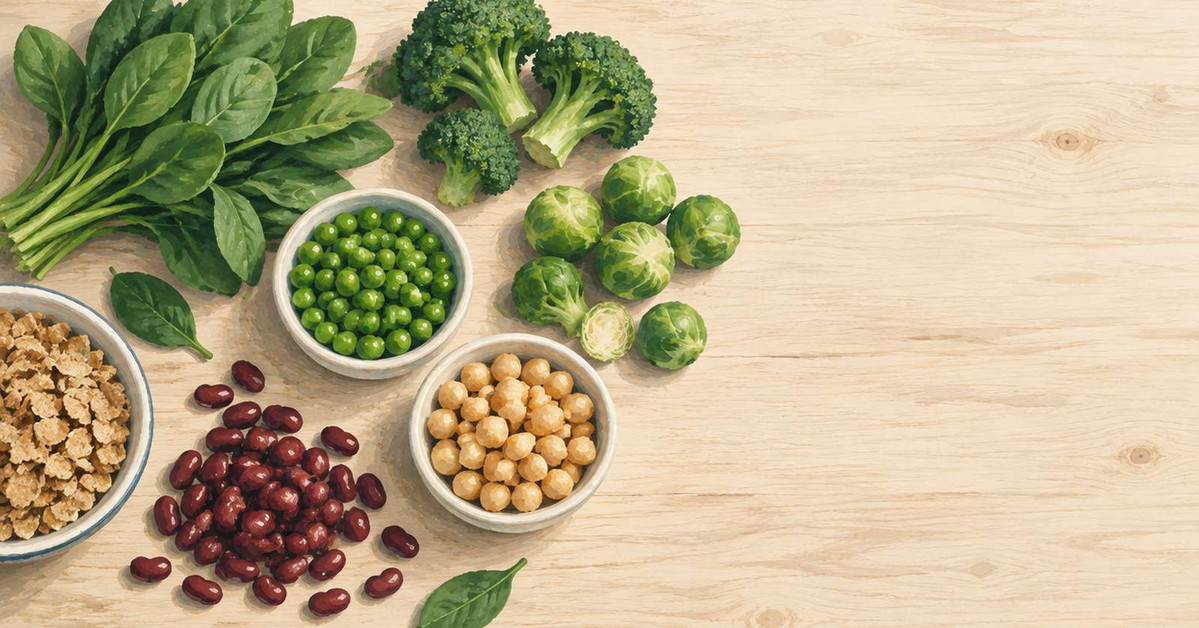
Good sources of folate include broccoli, brussels sprouts, leafy green vegetables such as cabbage, kale, spring greens and spinach, peas, chickpeas and kidney beans, liver, and breakfast cereals fortified with folic acid.1 Because the body doesn't store folate for long, eating some of these most days is the usual way men reach 200 micrograms.1
Small, ordinary choices across your week add up: spinach stirred into a stew, peas or broccoli with dinner, a chickpea or bean salad at lunch, or a fortified cereal at breakfast. From December 2026, bread and other foods made with non-wholemeal wheat flour will also contain added folic acid.11 For how folate sits beside vitamin D, zinc and the other nutrients in a preconception plan for both partners, see our fertility vitamins guide.
When should you see a GP?
See your GP if you and your partner have not conceived after a year of trying. The NHS advises women aged 36 and over, and anyone who already knows they may have fertility problems, to go sooner.15 More than 8 in 10 couples where the woman is under 40 conceive within a year of regular unprotected sex.15 If you've passed a year, you're far from alone: a year is simply the point the NHS picks to get checked, not a judgement on either of you. Both partners are usually assessed, and for men this normally includes a semen analysis, a test of a sperm sample.15
It's also worth talking to your GP before you take any high dose of folic acid, or if you've been told your vitamin B12 is low, because of the masking risk described above.1 If you take prescribed medicines, ask your GP or pharmacist before adding a supplement. Folic acid can interact with some medicines, including certain epilepsy medicines, some antibiotics, sulfasalazine and lithium.16
If you and your partner are already under a fertility clinic, keep to their advice on supplements and tell them what you take.
Frequently Asked Questions
Should men take folic acid when trying to conceive?
There's no UK recommendation for men to take folic acid for fertility, and most men get the 200 micrograms of folate they need from food.1 The largest trial found that high-dose folic acid with zinc did not improve semen quality or live birth rates.4 Your partner's folic acid matters more: the NHS advises 400 micrograms a day for women trying to conceive.3
How much folic acid should a man take a day?
Adult men need 200 micrograms of folate a day, usually from diet.1 If you take a supplement, keep folic acid from supplements and fortified foods at 1,000 micrograms a day or less unless your doctor advises otherwise.8 Higher doses, such as 5 milligrams (5,000 micrograms), are prescribed for specific medical reasons and need a GP's advice.3
Does folic acid improve sperm count?
Some small trials found higher sperm counts with folic acid and zinc, including a 74% rise in total normal sperm count in subfertile men in a 2002 Dutch trial.5 The much larger FAZST trial found no difference in sperm concentration, motility, morphology or live births after six months, and a slight rise in sperm DNA fragmentation.4
Can men take too much folic acid?
Yes. The NHS says doses of folic acid higher than 1 milligram (1,000 micrograms) a day can mask the symptoms of vitamin B12 deficiency, which can eventually damage the nervous system.1 The European Food Safety Authority's upper level for adults is 1,000 micrograms a day from supplements and fortified foods combined.8 Speak to your GP before taking more.
Is folate the same as folic acid?
They're closely related. Folate is vitamin B9 as it occurs naturally in foods such as leafy greens, peas and beans, and folic acid is the man-made form used in supplements and fortified foods.1 The 1,000 microgram daily upper limit applies to folic acid and other added forms such as methylfolate from supplements and fortified foods, not to the folate in ordinary food.8
What foods are high in folate?
Good sources include broccoli, brussels sprouts, leafy greens such as kale, spinach, cabbage and spring greens, peas, chickpeas, kidney beans, liver and fortified breakfast cereals.1 Eating vegetables and pulses most days is the simplest way for men to reach 200 micrograms of folate. From December 2026, non-wholemeal wheat flour in the UK will also contain added folic acid.11
Conceive for Men
Conceive for Men, our daily supplement for men, contains 400 micrograms of folic acid, 15 milligrams of zinc and 70 micrograms of selenium per two capsules, with other vitamins, amino acids and plant extracts. It contains dong quai, a herbal root used in traditional Chinese medicine that is not considered safe in pregnancy. It is not for your partner to take while trying to conceive or in pregnancy. Check with your GP first if you take a blood thinner such as warfarin.17
You can see the full ingredients alongside the rest of the range on our fertility supplements page.
Related Reading
If folate is on your list, these guides fill in the rest of the picture.
-
Male Fertility: A Complete Evidence-Based Guide
The pillar guide to sperm health, lifestyle and the nutrients that have been studied, with folate in context. -
Zinc and Male Fertility: What the Evidence Shows
The other nutrient in the FAZST trial, and what the zinc research does and doesn't show. -
What Is Sperm DNA Fragmentation?
What the measure means and what a raised result can and cannot tell you. -
Fertility Vitamins: What to Take When Trying to Get Pregnant
How folic acid fits with vitamin D, iodine and the other nutrients in a preconception plan for both partners.
References
- National Health Service (NHS). Vitamin B: folate and folic acid. Vitamins and minerals. www.nhs.uk/conditions/vitamins-and-minerals/vitamin-b. Accessed 26 September 2026.
- Crider KS, Yang TP, Berry RJ, Bailey LB. Folate and DNA methylation: a review of molecular mechanisms and the evidence for folate's role. Advances in Nutrition. 2012;3(1):21-38. doi.org/10.3945/an.111.000992
- National Health Service (NHS). Pregnancy vitamins and supplements. www.nhs.uk/pregnancy/keeping-well/pregnancy-vitamins-and-supplements. Accessed 26 September 2026.
- Schisterman EF, Sjaarda LA, Clemons T, et al. Effect of folic acid and zinc supplementation in men on semen quality and live birth among couples undergoing infertility treatment: a randomized clinical trial. JAMA. 2020;323(1):35-48. doi.org/10.1001/jama.2019.18714
- Wong WY, Merkus HM, Thomas CM, Menkveld R, Zielhuis GA, Steegers-Theunissen RP. Effects of folic acid and zinc sulfate on male factor subfertility: a double-blind, randomized, placebo-controlled trial. Fertility and Sterility. 2002;77(3):491-498. doi.org/10.1016/s0015-0282(01)03229-0
- Irani M, Amirian M, Sadeghi R, Lez JL, Latifnejad Roudsari R. The effect of folate and folate plus zinc supplementation on endocrine parameters and sperm characteristics in sub-fertile men: a systematic review and meta-analysis. Urology Journal. 2017;14(5):4069-4078. doi.org/10.22037/uj.v14i5.3772
- de Ligny W, Smits RM, Mackenzie-Proctor R, Jordan V, Fleischer K, de Bruin JP, Showell MG. Antioxidants for male subfertility. Cochrane Database of Systematic Reviews. 2022;5(5):CD007411. doi.org/10.1002/14651858.CD007411.pub5
- EFSA Panel on Nutrition, Novel Foods and Food Allergens (NDA). Scientific opinion on the tolerable upper intake level for folate. EFSA Journal. 2023;21(11):e08353. doi.org/10.2903/j.efsa.2023.8353
- Commission Regulation (EU) No 432/2012 establishing a list of permitted health claims made on foods (retained in GB law); GB Nutrition and Health Claims Register (folate, zinc and selenium entries). www.legislation.gov.uk/eur/2012/432/annex. Accessed 26 September 2026.
- Ebisch IM, Thomas CM, Peters WH, Braat DD, Steegers-Theunissen RP. The importance of folate, zinc and antioxidants in the pathogenesis and prevention of subfertility. Human Reproduction Update. 2007;13(2):163-174. doi.org/10.1093/humupd/dml054
- Food Standards Agency. Folic acid. GOV.UK. Published 25 June 2026, updated 10 July 2026. www.gov.uk/government/publications/folic-acid/folic-acid. Accessed 26 September 2026.
- Young SS, Eskenazi B, Marchetti FM, Block G, Wyrobek AJ. The association of folate, zinc and antioxidant intake with sperm aneuploidy in healthy non-smoking men. Human Reproduction. 2008;23(5):1014-1022. doi.org/10.1093/humrep/den036
- National Health Service (NHS). Others: zinc and selenium. Vitamins and minerals. www.nhs.uk/conditions/vitamins-and-minerals/others. Accessed 26 September 2026.
- Smits RM, Mackenzie-Proctor R, Yazdani A, Stankiewicz MT, Jordan V, Showell MG. Antioxidants for male subfertility. Cochrane Database of Systematic Reviews. 2019;3(3):CD007411. doi.org/10.1002/14651858.CD007411.pub4
- National Health Service (NHS). Infertility: overview and diagnosis. www.nhs.uk/conditions/infertility and www.nhs.uk/conditions/infertility/diagnosis. Accessed 29 September 2026.
- National Health Service (NHS). Folic acid: medicine. Taking folic acid with other medicines and supplements. www.nhs.uk/medicines/folic-acid. Accessed 26 September 2026.
- Memorial Sloan Kettering Cancer Center (MSKCC). Dong quai. About Herbs. www.mskcc.org/cancer-care/integrative-medicine/herbs/dong-quai. Accessed 29 September 2026.

Marina Carter
Health & Fertility Writer at FertilitySmart
Marina Carter is FertilitySmart's lead writer on fertility, preconception health, and reproductive nutrition. She translates the clinical and nutritional evidence base into honest, practical guidance for individuals and couples trying to conceive, working closely with the product team to ensure every article reflects current peer-reviewed research and the lived emotional reality of the fertility journey. Read Full Bio →