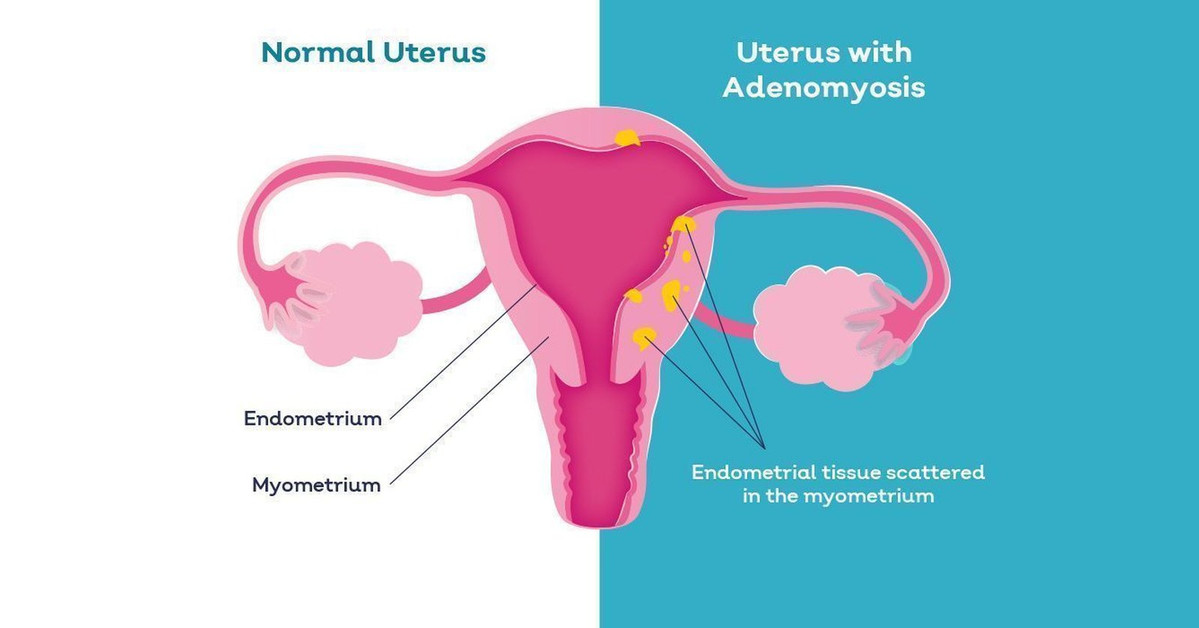
Women with adenomyosis can and do get pregnant. If you've been told you have, or may have, adenomyosis while you're trying to conceive, this guide sets out what the research found, where it falls short, and what you might want to ask your GP or fertility clinic.
Adenomyosis is a condition where the lining of the womb (uterus) grows into the muscle of the womb wall.1 The figures below come from women having IVF (in vitro fertilisation) or ICSI (intracytoplasmic sperm injection, a form of IVF where a single sperm is injected into an egg). A clinical pregnancy is one seen on an ultrasound scan. Reviews of these studies have found lower clinical pregnancy and live birth rates, and more miscarriages, in women with adenomyosis.2,3,4 These are group averages from fertility clinics, not a prediction for you. These studies are observational: they compare groups of women rather than testing a treatment, and they differ a lot from one another.2,3
- Adenomyosis means tissue like the womb lining grows into the muscle wall of the womb. Endometriosis is similar tissue growing outside the womb, and the two can occur together.1,5
- Reviews of IVF and ICSI studies link adenomyosis with lower clinical pregnancy and live birth rates and a higher miscarriage rate. The studies define and measure adenomyosis in different ways.2,4
- Much less is known about natural conception. A 2012 review found little data, and no evidence that adenomyosis should be looked for and treated in everyone hoping to conceive.6
- Reviews of treatment before IVF and of surgery rest mostly on non-randomised studies and have not shown a clear rise in live births.7,8,9
- If you've already been trying to conceive for a year or more, ask your GP about a referral to a fertility clinic. Otherwise, the NHS advises seeing a GP after a year of trying, or sooner if you're 36 or over or know of a possible fertility problem.10 See a GP too if your periods become more painful or heavier.1 Our search of NICE guidance (NICE writes health guidance for the NHS in England) found no guideline on adenomyosis and fertility.11
What is adenomyosis, and how is it different from endometriosis?
Adenomyosis is when the lining of the womb starts growing into the muscle in the womb wall. Endometriosis is a different condition, where tissue similar to the womb lining grows in other places, such as the ovaries or fallopian tubes.1 The two can happen together, and their symptoms can overlap.5,11
In a study of 985 women having a scan at a general gynaecology clinic, adenomyosis was more common in women who also had endometriosis in the pelvis, in older women and in women who had been pregnant before.5 NICE reminds doctors that pain alongside heavy periods may be caused by endometriosis rather than adenomyosis, so finding one does not rule out the other.11
It's not clear what causes adenomyosis. The NHS says symptoms usually affect women over the age of 35, and that you may be more likely to get it if you have given birth or have endometriosis.1
How common is adenomyosis?
Estimates vary, partly because adenomyosis used to be confirmed only after a hysterectomy.5 In the same study, transvaginal ultrasound (a scan using a small probe placed in the vagina) found adenomyosis in 206 of 985 women (20.9%) attending the clinic.5 The researchers expected the figure to be lower in women in general, because the women they scanned had symptoms.5
If you're having difficulty conceiving, you may want to know how this applies to you. Among women with fertility problems, a 2012 systematic review found there was little data on how common adenomyosis is.6
What are the symptoms of adenomyosis?
The NHS lists painful periods, heavy periods, pelvic pain, bloating or a feeling of heaviness in the tummy, and pain during or after sex as symptoms of adenomyosis. Some people with adenomyosis have no symptoms at all.1 Many of these symptoms overlap with other conditions, which is why tests are sometimes needed.1
Period pain from adenomyosis can be severe enough to stop you doing your usual activities.1 Because endometriosis can cause similar pain, a GP may suggest tests to rule it out.1
How is adenomyosis diagnosed in the UK?
It usually starts with your GP, who will ask about your periods and may feel your tummy and offer an internal examination.1 For women with heavy periods who also have significant period pain or a bulky, tender womb, NICE advises offering a transvaginal ultrasound scan first.11 If you decline it or it is not suitable, NICE says an abdominal scan or MRI can be considered.11
You can ask for a female doctor when you book, and you can have a friend, family member or member of staff with you during an examination.1
A 2012 review found that ultrasound and MRI were similarly accurate at diagnosing adenomyosis.6 In 2015, and again in 2022, international specialists agreed shared terms so that scan reports describe adenomyosis in the same way.12,13
If adenomyosis is first mentioned on a fertility scan report, ask what the report says and whether it changes your plan.
Does adenomyosis affect your chances of conceiving naturally?
There is little research on this. A 2012 systematic review found little data on adenomyosis in people trying to conceive, and concluded there was no evidence that adenomyosis should be looked for and treated in everyone who wants to conceive.6 Most research since then has studied women having IVF or ICSI.3
Most women in these IVF studies were having treatment because they had difficulty conceiving, so their results may not apply to everyone with adenomyosis. Because research on natural conception is so limited, a diagnosis of adenomyosis on its own cannot tell you whether you will have trouble conceiving.6 The GP section near the end of this guide explains when to ask for help.
Very few studies have looked at treatment before trying naturally. In the few that did, reviewed in 2017 and 2022, women with adenomyosis who had surgery became pregnant without fertility treatment more often than women with adenomyosis who did not have surgery.4,14 The 2022 review based this on only two studies.4 The 2017 review reported a similar pattern after GnRH agonist treatment (a medicine that temporarily switches off the hormones made by the ovaries).14 The reviews' summaries report pregnancies, not live births, so they do not show that surgery leads to more babies.4,14
What does the research show for IVF and ICSI?
Several reviews have found lower pregnancy rates with adenomyosis. A 2014 review of 9 studies with 1,865 women found clinical pregnancy after IVF or ICSI in 40.5% of women with adenomyosis and 49.8% of women without it.2 These are the raw rates across the women whose results were reported (1,566 of the 1,865); when the review combined each study's own result, the chance came out a little over a quarter lower with adenomyosis (risk ratio 0.72).2 A 2022 review also found lower live birth rates in women with adenomyosis.4
A 2017 review of 11 studies, with 519 women with adenomyosis and 1,535 without, found lower rates of implantation, clinical pregnancy, ongoing pregnancy and live birth in women with adenomyosis, and a higher miscarriage rate.14 A 2021 review of 17 studies found a lower clinical pregnancy rate after assisted reproduction, and the link held after allowing for age.3 If the terms in the table below are new to you, a risk ratio compares how often something happened in each group, and an odds ratio is a closely related measure. For both, a figure lower than one means the outcome was less common with adenomyosis, and higher than one means more common.
Reviews of IVF and ICSI outcomes in women with and without adenomyosis
| Review | What it found |
|---|---|
| Vercellini 20142 (9 studies, 1,865 women) | Clinical pregnancy a little over a quarter less likely with adenomyosis (risk ratio 0.72). Miscarriage about twice as common (risk ratio 2.12). |
| Younes and Tulandi 201714 (11 studies, 2,054 women) | Lower rates of implantation (the embryo attaching to the womb lining), clinical pregnancy, ongoing pregnancy and live birth with adenomyosis, and a higher miscarriage rate. |
| Nirgianakis 20213 (17 studies) | Clinical pregnancy less likely with adenomyosis (odds ratio 0.69). Miscarriage roughly twice the odds (odds ratio 2.17). |
| Cozzolino 20224 | Live birth and clinical pregnancy less likely with adenomyosis (odds ratios 0.59 and 0.66). Miscarriage roughly twice the odds (odds ratio 2.11). |
All of these reviews pooled observational studies, not randomised trials, and the studies defined and scanned for adenomyosis in different ways. In the 2014 review, the result became uncertain when one study was left out.2 The 2022 review noted that most studies did not separate focal adenomyosis (in one area) from diffuse adenomyosis (spread through the wall), which may matter.4
Is miscarriage or a pregnancy complication more likely with adenomyosis?
Reviews have found higher miscarriage rates in women with adenomyosis. In the 2014 IVF review, 31.9% of pregnancies in women with adenomyosis ended in miscarriage, compared with 14.1% in women without it, although the studies varied widely.2 Even so, most pregnancies in both groups did not end in miscarriage. A 2019 review of 104 papers on adenomyosis and endometriosis also found a higher risk of miscarriage with adenomyosis.15
A 2021 review found that adenomyosis was also linked with higher rates of several pregnancy complications.3 These were pre-eclampsia (a condition causing high blood pressure in pregnancy), preterm birth, caesarean birth, the baby lying in an unusual position, a baby smaller than expected, and heavy bleeding after the birth.3 The links held after allowing for the mother's age and for how the pregnancy was conceived.3
These are links, not proof: they show that these problems were more common in women with adenomyosis, not that adenomyosis caused them. The reviewers suggest a discussion of risks before fertility treatment and closer monitoring in pregnancy for women with adenomyosis.3,15 If you're pregnant and have adenomyosis, it's worth making sure your midwife knows about the diagnosis.
These figures describe groups of women, not what will happen to you, and your own team can put them in context.
What treatments are discussed in fertility care?
There is no agreed single approach yet.16 The options most often discussed are a period of GnRH agonist treatment before embryo transfer (when an embryo made through IVF is placed in the womb), and, for some women, surgery to remove an area of adenomyosis. The reviews of both rest mainly on non-randomised studies.7,9
GnRH agonist treatment before embryo transfer
A 2024 review combined 8 retrospective studies (which looked back at past treatment records), with 2,422 women with adenomyosis. Women who had at least a month of GnRH agonist treatment before IVF or ICSI had higher implantation and clinical pregnancy rates, but there was no clear difference in live births or miscarriages, and the authors called the benefit uncertain.7
A fresh embryo transfer uses an embryo in the same treatment cycle, and a frozen one uses an embryo that was frozen and thawed later. A 2025 review of 10 studies found a higher clinical pregnancy rate with this treatment before a fresh embryo transfer, but no clear difference before a frozen one, and no benefit for live births or miscarriage.8 The 2022 review, which included three studies on this question, found no improvement in IVF outcomes.4
A UK randomised trial was set up to compare six weeks of GnRH agonist treatment with one week before frozen embryo transfer in women with moderate or severe adenomyosis, with clinical pregnancy as its main outcome.16 No published results had appeared when we checked in October 2026.
Surgery (adenomyomectomy)
Adenomyomectomy is an operation to remove an area of adenomyosis while keeping the womb. A 2025 review brought together 32 non-randomised studies, with 2,501 women having different treatments that keep the womb.9 It looked at treated women only, with no untreated comparison group, so it cannot show whether surgery changed anyone's chance of pregnancy.9 Across the studies, about half of the women who had adenomyomectomy became pregnant (50.1%) and about 4 in 10 gave birth (39.5%).9 In the same review, 19.8% of pregnancies after adenomyomectomy ended in a pregnancy loss (which the review defined as miscarriage, ectopic pregnancy, stillbirth or termination), and the preterm birth rate was 18.4%.9
In that review, almost all babies born after adenomyomectomy were delivered by caesarean, and one included study, in which 21 of 70 women became pregnant after adenomyomectomy, reported two cases of the womb tearing during pregnancy (uterine rupture).9 If surgery is suggested, it's reasonable to ask how it might affect a future pregnancy and birth.
When you're not trying to conceive
For heavy periods with suspected or diagnosed adenomyosis, NICE advises considering a levonorgestrel intrauterine system (LNG-IUS, a hormonal coil such as Mirena) as the first treatment.11 The NHS also lists other hormonal contraception and medicines such as tranexamic acid or anti-inflammatory painkillers.1 Anti-inflammatory painkillers such as ibuprofen may not be suitable if you're trying to get pregnant or are pregnant, so check with a pharmacist or GP first.17 The hormonal options are contraceptives, so they suit times when you're not trying to get pregnant.
If these do not help, the NHS lists uterine artery embolisation (a procedure that blocks the blood supply to the affected part of the womb) or a hysterectomy.1 You can no longer get pregnant after a hysterectomy.18
What do UK and European guidelines say?
As of October 2026, NICE had published no guideline on adenomyosis and fertility. Its guideline on heavy periods covers how suspected adenomyosis is investigated and how heavy periods are treated. Its endometriosis guideline mentions adenomyosis only once, in a recommendation about hysterectomy.11,19
NICE also has guidance on uterine artery embolisation for adenomyosis (a procedure that blocks blood vessels feeding the womb), which says its effects on fertility are uncertain.20 ESHRE (the European Society of Human Reproduction and Embryology) published an endometriosis guideline in 2022, which does not set out recommendations for adenomyosis.21 ESHRE's good practice recommendations on adenomyosis were listed as under review when we checked on 13 October 2026.22
What is still uncertain?
Many basic questions are still open. Most studies use different definitions and scanning methods, and report pregnancy rather than live birth.2,4 Researchers do not yet know whether treating adenomyosis before IVF leads to more babies, or how much the type and extent of adenomyosis matter.4,7
- Type of adenomyosis: most studies did not separate focal from diffuse adenomyosis.4
- Live births: the 2014 review's authors asked for future studies to make live birth the main outcome.2
- Natural conception: most studies looked at women having IVF, and a 2012 review called for more research on fertility with and without treatment.6
- Diet and supplements: our search of Europe PMC, a large medical research database that includes PubMed, in October 2026 found no trial showing that a diet or supplement improves fertility in women with adenomyosis.
If any of these gaps matter to your own plans, the questions in the next section may help you raise them with your clinic.
When should you see a GP, and what can you ask?
See a GP if your periods become more painful, heavier or irregular, or if heavy periods are affecting your life. The NHS also advises seeing a GP if you bleed between periods or after sex, have pain during or after sex, or have felt bloated for about 3 weeks.1 Ask for an urgent GP appointment or contact NHS 111 if your pelvic or period pain is severe or worse than usual and painkillers have not helped.1
For fertility, the NHS advises seeing a GP if you have not conceived after a year of trying, and sooner if you're a woman aged 36 or over or already know you may have a fertility problem.10 If you have been diagnosed with adenomyosis, it's reasonable to mention it early rather than wait. If you've already been trying for a year or more, ask your GP about a referral to a fertility clinic, and ask for your scan report to go with it.
If you'd like to talk things through, every fertility clinic licensed by the HFEA (the UK's fertility regulator) must offer you the chance to see a counsellor before treatment starts.23 Your GP can also tell you about counselling on the NHS.23
Some questions you might want to ask:
- What type of adenomyosis do I have, and where is it?
- Does this change when I should have fertility tests or a referral?
- If I have IVF, would you suggest any treatment before embryo transfer, and what is the evidence for it?
- How might adenomyosis affect a future pregnancy, and what extra care would I have?
- Which treatments for my symptoms can I use while trying to conceive?
If you are trying to conceive without a clear cause, our guide to unexplained infertility explains the usual tests and next steps.
Frequently Asked Questions
Can you get pregnant with adenomyosis?
Yes, women with adenomyosis can and do get pregnant. In IVF and ICSI studies, the chance of a clinical pregnancy was somewhat lower with adenomyosis, but many women with adenomyosis still became pregnant.2 Research on natural conception is limited, so if you have adenomyosis and are trying to conceive, talk to your GP about when to seek help.
Does adenomyosis cause infertility?
Studies link adenomyosis with lower pregnancy rates during IVF and ICSI, but they show a link rather than proof that adenomyosis is the cause.3 Adenomyosis is more often found in older women and in women who also have endometriosis, and age and endometriosis can each affect fertility, which makes cause and effect hard to separate.1,5,10 Evidence on natural conception is limited.
What is the difference between adenomyosis and endometriosis?
In adenomyosis, the lining of the womb grows into the muscle of the womb wall. In endometriosis, tissue similar to the womb lining grows in other places, such as the ovaries or fallopian tubes.1 The two can occur together, and both can cause painful periods, which is why scans are sometimes needed to tell them apart.
Does adenomyosis increase the risk of miscarriage?
Reviews have found higher miscarriage rates in women with adenomyosis; the miscarriage section above gives the figures from a 2014 IVF review.2 Even so, most pregnancies in both groups in that review did not end in miscarriage. These studies compare groups of women, and their results varied. If you're worried, ask your clinic or GP what this means for you.
Should adenomyosis be treated before IVF?
There is no agreement yet. Reviews suggest a month or more of GnRH agonist treatment before IVF may raise clinical pregnancy rates, but they found no clear difference in live births, and most studies were retrospective.7,8 A UK randomised trial was set up to test this, but its results had not appeared when we checked in October 2026.16 Ask your clinic whether it suits you.
Can diet or supplements improve fertility with adenomyosis?
Our search of published research in October 2026 found no trial showing that a diet or supplement improves fertility in women with adenomyosis. The reviews in this guide cover medical treatments and surgery. If you're thinking about changing your diet or taking anything new, talk it through with your GP or fertility clinic first.
Related Reading
-
Unexplained Infertility: What It Means and What You Can Do
the usual tests and next steps when no clear cause is found. -
AMH Levels and Fertility
what this common fertility blood test measures and what it does not tell you.
References
- National Health Service (NHS). Adenomyosis. Page last reviewed 14 October 2026 (next review due 14 October 2029). https://www.nhs.uk/conditions/adenomyosis/. Accessed 3 November 2026.
- Vercellini P, Consonni D, Dridi D, Bracco B, Frattaruolo MP, Somigliana E. Uterine adenomyosis and in vitro fertilization outcome: a systematic review and meta-analysis. Human Reproduction. 2014;29(5):964-977. doi:10.1093/humrep/deu041
- Nirgianakis K, Kalaitzopoulos DR, Schwartz ASK, Spaanderman M, Kramer BW, Mueller MD, Mueller M. Fertility, pregnancy and neonatal outcomes of patients with adenomyosis: a systematic review and meta-analysis. Reproductive BioMedicine Online. 2021;42(1):185-206. doi:10.1016/j.rbmo.2020.09.023
- Cozzolino M, Tartaglia S, Pellegrini L, Troiano G, Rizzo G, Petraglia F. The effect of uterine adenomyosis on IVF outcomes: a systematic review and meta-analysis. Reproductive Sciences. 2022;29(11):3177-3193. doi:10.1007/s43032-021-00818-6
- Naftalin J, Hoo W, Pateman K, Mavrelos D, Holland T, Jurkovic D. How common is adenomyosis? A prospective study of prevalence using transvaginal ultrasound in a gynaecology clinic. Human Reproduction. 2012;27(12):3432-3439. doi:10.1093/humrep/des332
- Maheshwari A, Gurunath S, Fatima F, Bhattacharya S. Adenomyosis and subfertility: a systematic review of prevalence, diagnosis, treatment and fertility outcomes. Human Reproduction Update. 2012;18(4):374-392. doi:10.1093/humupd/dms006
- Latif S, Kastora S, Al Wattar BH, Yasmin E, Saridogan E, Mavrelos D. The effectiveness of prolonged downregulation with gonadotrophin-releasing hormone analogue (GnRHa) treatment in women with adenomyosis undergoing IVF/ICSI: a systematic review and meta-analysis. European Journal of Obstetrics and Gynecology and Reproductive Biology. 2024;301:87-94. doi:10.1016/j.ejogrb.2024.07.063
- Galati G, Olivieri C, Cosentino M, Azenkoud I, Cugini S, Sorrenti G, Rizzo G, Muzii L. Medical treatment before in-vitro fertilization in patients with adenomyosis: a systematic review and meta-analysis. Journal of Assisted Reproduction and Genetics. 2025;42(2):381-388. doi:10.1007/s10815-024-03323-2
- Liu L, Wang T, Li Y, Tian H, Zhou C, Cai W. Reproductive outcomes after fertility-sparing interventions for symptomatic adenomyosis: a systematic review and meta-analysis. BMC Pregnancy and Childbirth. 2025;25(1):1178. doi:10.1186/s12884-025-08323-3
- National Health Service (NHS). Infertility. Page last reviewed 9 August 2023. https://www.nhs.uk/conditions/infertility/. Accessed 13 October 2026.
- National Institute for Health and Care Excellence (NICE). Heavy menstrual bleeding: assessment and management (NG88). Published 14 March 2018, last updated 7 July 2026. https://www.nice.org.uk/guidance/ng88. Accessed 13 October 2026.
- Van den Bosch T, Dueholm M, Leone FP, Valentin L, Rasmussen CK, Votino A, et al. Terms, definitions and measurements to describe sonographic features of myometrium and uterine masses: a consensus opinion from the Morphological Uterus Sonographic Assessment (MUSA) group. Ultrasound in Obstetrics and Gynecology. 2015;46(3):284-298. doi:10.1002/uog.14806
- Harmsen MJ, Van den Bosch T, de Leeuw RA, Dueholm M, Exacoustos C, Valentin L, et al. Consensus on revised definitions of Morphological Uterus Sonographic Assessment (MUSA) features of adenomyosis: results of modified Delphi procedure. Ultrasound in Obstetrics and Gynecology. 2022;60(1):118-131. doi:10.1002/uog.24786
- Younes G, Tulandi T. Effects of adenomyosis on in vitro fertilization treatment outcomes: a meta-analysis. Fertility and Sterility. 2017;108(3):483-490.e3. doi:10.1016/j.fertnstert.2017.06.025
- Horton J, Sterrenburg M, Lane S, Maheshwari A, Li TC, Cheong Y. Reproductive, obstetric, and perinatal outcomes of women with adenomyosis and endometriosis: a systematic review and meta-analysis. Human Reproduction Update. 2019;25(5):592-632. doi:10.1093/humupd/dmz012
- Latif S, Al Wattar BH, Balachandren N, Lukaszewski T, Saridogan E, Yasmin E, Serhal P, Mavrelos D. Effectiveness of modified downregulation for women with moderate and severe adenomyosis of the uterus prior to frozen thawed embryo transfer (MODA) study protocol: a pragmatic randomised controlled trial. BMJ Open. 2021;11(10):e050248. doi:10.1136/bmjopen-2021-050248
- National Health Service (NHS). Ibuprofen for adults. https://www.nhs.uk/medicines/ibuprofen-for-adults/. Accessed 13 October 2026.
- National Health Service (NHS). Hysterectomy. Page last reviewed 11 October 2022. https://www.nhs.uk/tests-and-treatments/hysterectomy/. Accessed 13 October 2026.
- National Institute for Health and Care Excellence (NICE). Endometriosis: diagnosis and management (NG73). Published 6 September 2017, last updated 11 November 2024. https://www.nice.org.uk/guidance/ng73. Accessed 13 October 2026.
- National Institute for Health and Care Excellence (NICE). Uterine artery embolisation for treating adenomyosis (HTG324, previously IPG473). Published 16 December 2013. https://www.nice.org.uk/guidance/htg324. Accessed 13 October 2026.
- Becker CM, Bokor A, Heikinheimo O, Horne A, Jansen F, Kiesel L, et al. ESHRE guideline: endometriosis. Human Reproduction Open. 2022;2022(2):hoac009. doi:10.1093/hropen/hoac009
- European Society of Human Reproduction and Embryology (ESHRE). Guidelines and good practice recommendations under development (ESHRE Good Practice Recommendations on Adenomyosis: under review). https://www.eshre.eu/Guidelines-and-Legal/Guidelines/Guidelines-in-development. Accessed 13 October 2026.
- Human Fertilisation and Embryology Authority (HFEA). Getting emotional support. Published 11 March 2016, last reviewed 8 September 2026. https://www.hfea.gov.uk/treatments/explore-all-treatments/getting-emotional-support/. Accessed 13 October 2026.

Marina Carter
Health & Fertility Writer
Marina Carter is FertilitySmart's lead writer on fertility, preconception health, and reproductive nutrition. She translates the clinical and nutritional evidence base into honest, practical guidance for individuals and couples trying to conceive, working closely with the product team to ensure every article reflects current peer-reviewed research and the lived emotional reality of the fertility journey. Read Full Bio →